Static Features
Static features are predefined, engineered inputs that remain constant across training iterations.
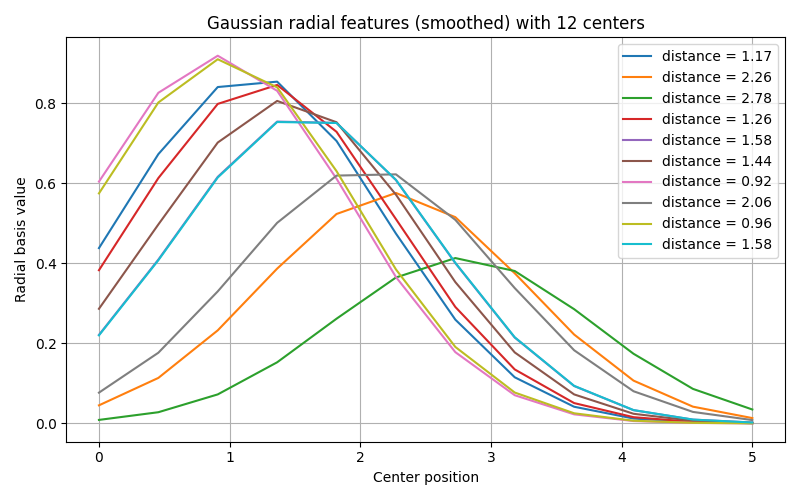
The model will use two kinds of descriptors for distances (radial symmetry functions) and directional features (Spherical harmonics).
Radial symmetry functions
We will use \(d = 1, ..., B\) radial symmetry functions of the form:
\[f_d(r_{ij}) = e^{-\eta_B (r_{ij} - R_B)^2} f_c(r_{ij})\]
where \(r_{ij}\) is the distance between atoms \(i\) and \(j\), \(\eta_B\) and \(R_B\) are parameters controlling the width and center of the function, and \(f_c\) is a cutoff function defined as:
\[\begin{split}f_c(r) =
\begin{cases}
0.5 \left[ \cos\left(\frac{\pi r}{r_c}\right) + 1 \right] & r \leq r_c \\
0 & r > r_c
\end{cases}\end{split}\]
with \(r_c\) being the cutoff radius.
Spherical Harmonics
For directional features, we will use spherical harmonics defined as:
\[Y_{lm}(\theta, \phi) = \sqrt{\frac{(2l + 1)}{4\pi} \frac{(l - m)!}{(l + m)!}} P_{lm}(\cos\theta) e^{im\phi}\]
where \(P_{lm}\) are the associated Legendre polynomials, and \(\theta\) and \(\phi\) are the polar and azimuthal angles, respectively.